
The Need for Reform in the States
Initiatives to implement amended expert evidence admission standards in FRE 702 are accelerating, and efforts to secure aligned state rules are expanding in 2025. Working groups in over a dozen states are advocating for state expert evidence rule amendments, including new groups in Indiana and Tennessee. These initiatives will build on the adoption of amended rules in six jurisdictions in 2024.
“We have rule amendment proposals filed in numerous states and state legislation is being pursued where necessary. We anticipate these initiatives, conducted in collaboration with state defense bar organizations, will help secure additional state rule amendments in 2025,” said Leah Lorber, LCJ Expert Evidence Committee Co-Chair.
Progress By State
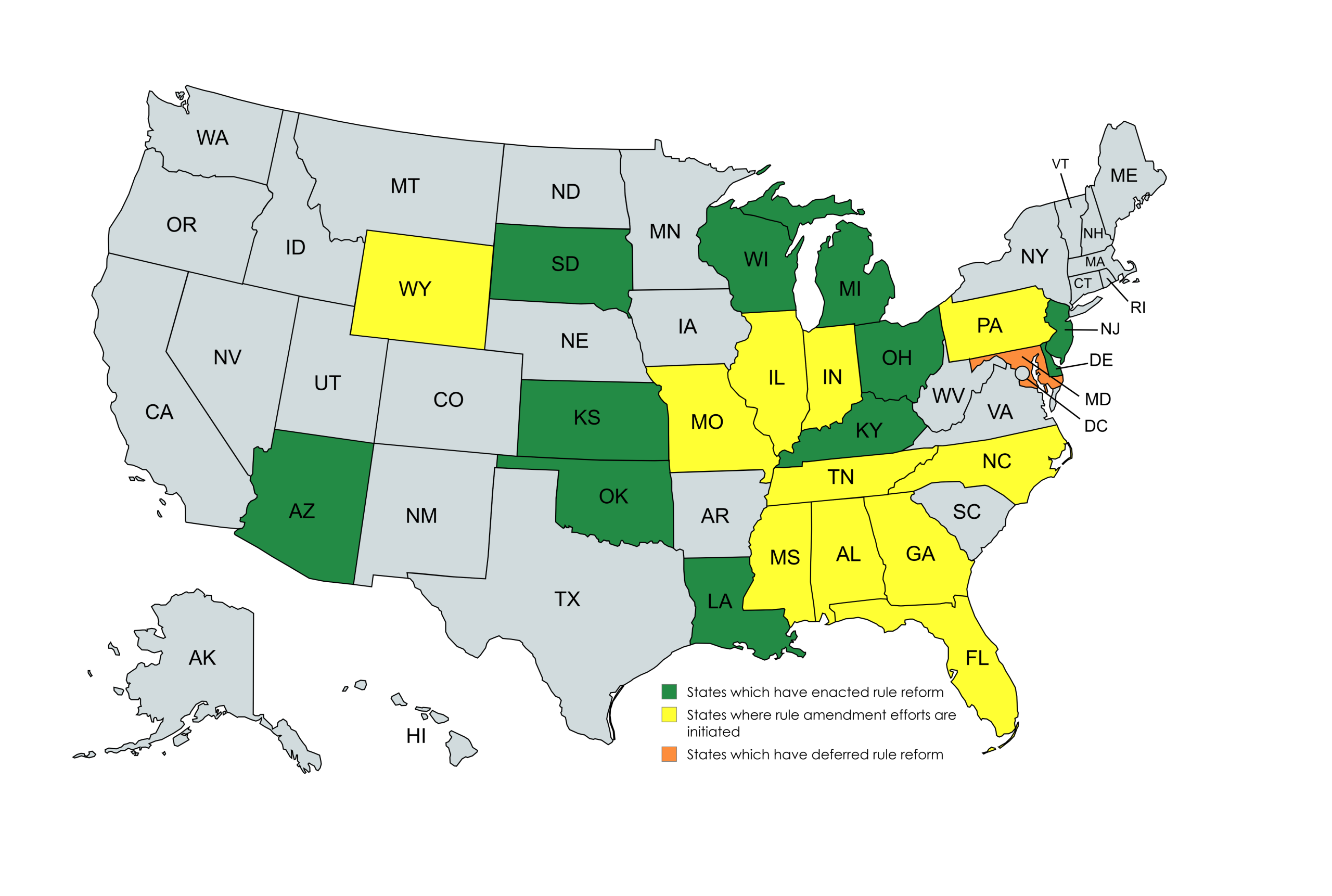
Many states are moving towards adoption of rule reforms in alignment with the federal 702 amendment.
Different states enact such changes in different ways – some through the judiciary and others through legislative action.
The Arizona Supreme Court issued an order in August 2023 amending its expert evidence rule to conform with the anticipated amendment to Federal Rule of Evidence 702. Arizona Rule of Evidence 702 took effect on January 1, 2024.
https://www.azcourts.gov/rules/Rule-Amendments-from-Recent-Rules-Agenda-s
Alabama Rule of Evidence 702 tracks pre-amendment Federal Rule of Evidence 702. A rule change to ensure that Alabama’s expert evidence rule continues to conform to the federal rule remains under consideration by the Alabama Supreme Court’s Evidentiary Rules Committee.
The Delaware Supreme Court in the In Re Zantac (Ranitidine) Litigation held that Delaware follows the standard for expert evidence admissibility set forth in amended FRE 702. The Court found that Rule 702 was “amended to clarify the rule without changing its substance” and that 2023 amendments to the federal rule confirm that the “trial courts are required to vigorously exercise their gatekeeping function.” The trial court, like other Delaware courts, cited incorrect standards which presumed the admissibility of expert testimony and allowed experts to testify without applying reliable scientific methodology to reach their conclusions. The Court wrote that “DRE 702 has not been amended at the present time to mirror the 2023 amendments to FRE 702. But, because the [Federal] Advisory Committee has explained that the 2023 amendments … “only clarified the existing federal standard, we view the committee’s recent guidance as important material to consider in reviewing our trial courts’ decision and providing guidance to litigants.”
LCJ’s amicus brief in In Re Zantac, prepared by Raffi Melkonian, with Wright Close & Barger LLP, urged the Delaware Supreme Court to interpret DRE 702 consistent with amended FRE 702 and addressed in detail the clarification to FRE 702 adopted by the Federal Courts.
The Florida State Bar’s Code and Rules of Evidence Committee (CREC) has approved a proposed amendment to the Florida Code of Evidence to bring the state’s expert evidence rule more closely into alignment with FRE 702. The proposal amending Code of Evidence section 90.702 was presented on February 4th by committee member Katherine Mastrucci (Shook Hardy & Bacon). The Florida Bar will now commence the process to bring the proposed amendment to the Florida legislature for consideration. A Florida working group is actively supporting the rule change. If you are interested in supporting this effort or participating in the Florida working group, please contact Dan Steen at dsteen@lfcj.com.
A change to Georgia’s expert evidence admission standards to make them consistent with FRE 702 requires legislative action adopting the change. An amendment to Georgia Rule of Evidence is endorsed by the Georgia Defense Lawyers Association and a working group of Georgia lawyers continues to seek an amendment to the state code of evidence. Please contact Dan Steen at dsteen@lfcj.com if you are interested in participating in the Georgia Working Group.
While efforts on behalf of codification of the rule continue, the Georgia Court of Appeals ruled in Sterigencs U.S. v. Mutz (2025) that Georgia’s admission practices are largely aligned with federal standards: Georgia trial courts must act as gatekeepers and assess the reliability of proposed expert testimony; they must consider whether the expert’s methodology is sufficiently reliable; and the proponent of the expert testimony bears the burden of establishing that reliability or the testimony will not be admitted. Lisa Baird, in her analysis in the Drug and Medical Device blog applauds the state court decision, “to the extent it is has better aligned state practice with federal standards and reinforced the importance of rigorous judicial scrutiny of expert causation testimony.”
An Illinois Working Group advocates for statutory amendments to the Illinois expert evidence standard. Illinois Rule of Evidence 702 currently follows the “Frye” standard which permissively allows expert evidence to go before juries, For more details on how to participate in the working group, please contact LCJ Executive Director Dan Steen, Dsteen@lfcj.com, or Elizabeth Chiarello at Alston & Bird, elizabeth.chiarello@alston.com
The Indiana Supreme Court has the authority to amend and rescind rules of practice and procedure and its Committee on Rules of Practice and Procedure also serves as the State’s Evidence Rules Review Committee. A working group, led by Joe Eaton (Barnes & Thornburg) has been formed to prepare a proposed rule change to the Committee. If you are interested in participating in the working group to support the amendment, please contact Dan Steen at DSteen@lfcj.com.
Kansas expert evidence legislation, unanimously adopted by the Kansas Senate and by House, was signed by Governor Laura Kelly on April 7, 2026. SB 398 amends Kansas’s expert evidence rule to align with FRE 702. Kansas becomes the ninth jurisdiction to align its expert evidence rules with the federal expert evidence admissibility standards, joining Arizona, Kentucky, Louisiana, Michigan, Ohio, Oklahoma, the US Virgin Islands, and Wisconsin.
The legislative effort on behalf of the bill was led by the Kansas Chamber of Commerce and Kansas Chamber President Eric Stafford. The bill was supported by an array of legal and business organizations, including the Kansas Association of Defense Counsel (KADC), the Kansas Motor Carriers Association (KMCA), the Kansas Federation of Independent Business, the Kansas Association of Property and Casualty Insurance Companies Inc., and the Kansas Board of Indigent Services. For more information, contact LCJ Executive Director Dan Steen. Read the enrolled version of Kansas SB 398 here.
The Kentucky Supreme Court approved an amendment to KRE 702 to align the state rule with amended FRE 702. The rule, attached here, became effective on July 1, 2024.
The Kentucky Supreme Court’s action followed a public comment period, coinciding with mandated state legislature review. All comments received by the Court were in support. The Kentucky Supreme Court also held a listening session on this and other rule changes at the Kentucky Bar Convention on May 9.
David Schaefer, with Dinsmore & Shohl in Louisville, made the initial presentation in support of amending KRE 702 in the summer of 2023 and led advocacy efforts leading to the adoption of the amendment. The Kentucky Defense Counsel, joined by the DRI, IADC, FDCC, ADTA, and LCJ, submitted a public comment on April 11, 2024, in support of the rule change. See the Comment here.
Louisiana adopted by statute an amendment to Louisiana Code of Evidence Article 702, to bring the state into alignment with Federal Rule of Evidence 702. The rule change became effective on August 1, 2024. View the text of the legislation here.
Lloyd “Sonny” Shields (Irwin Fritchie Urquhart Moore & Daniels, LLC), a member of the Louisiana Law Institute Civil Procedure Committee, proposed the rule amendment to bring Louisiana Code of Evidence Article 702 into alignment with the amended federal rule. The Civil Procedure Committee recommended and the Louisiana Supreme Court approved the amendment. The rule change was referred to the Louisiana State Legislature for approval. Following consideration by the Senate Judiciary Committee, the bill was adopted by the Louisiana Senate by a vote of 38-0. The Louisiana House passed SB 16 by a vote of 90-0. The bill implementing the amended expert evidence rule was signed into law by Louisiana’s Governor on May 21.
The Maryland Supreme Court recognizes amended FRE 702 as an analog to Maryland Rule 5-702. The Court cites the commentary of the federal Advisory Committee on Evidence Rules accompanying the 2023 amendment to FRE 702 in support of its decision advising trial courts to exercise “meaningful gatekeeping as to an expert opinion’s factual basis” and use of the “preponderance standard” in applying expert evidence “reliability requirements.” Maryland recognizes that critical questions of the sufficiency of an expert’s basis, and the application of the expert’s methodology generally, go to admissibility and not weight. Katz, Abosch, Windesheim, Gershman & Freedman, P.A. et al. v. Parkway Neuroscience and Spine Institute, LLC, (Md. S.Ct., August 30, 2023). Although the Maryland Supreme Court recognizes the analogous federal rule, it has not yet adopted the amended federal rule language. In 2024, the Court declined, without comment, to implement the recommendation of Maryland’s Standing Committee on Rules of Practice and Procedure to amend Rule 5-702. The Supreme Court’s April 5, 2024 order is found here. LCJ’s comment in support of the rule change, prepared by Mark Behrens and Chris Appel with Shook Hardy, can be found here.
The Michigan Supreme Court has adopted an amendment to Michigan Rule of Evidence 702 on expert evidence admissibility, which went into effect on May 1st,2024. You can read the order here:
Mary Massaron, of Plunkett Cooney, and Mark Behrens, of Shook Hardy, led advocacy efforts on behalf of the amended rule. Mary and Mark prepared and filed the linked public comment filed with the Michigan Supreme Court. Massaron and Behrens Comment on Proposed Michigan Rule of Evidence 702 Amendment
January 31, 2024
View Comment Letter
Mississippi Rule of Evidence 702 is aligned with federal evidentiary standards on expert evidence. A proposed amendment to MRE 702 is now pending which would maintain the consistency between the state rule and FRE 702. The Mississippi Supreme Court has referred the proposed rule change to its Advisory Committee on Rules of Civil Practice and Procedure for research and a recommendation.
The amendment was proposed in a letter by Chris Maddux, William Gage, Rod Richmond, Tim Threadgill, and Phillip Sykes, all with the Butler Snow firm, which highlights that “Mississippi … has followed the federal standards for the admissibility of expert witness testimony for more than 20 years.” The Butler Snow lawyers argue the “changes are critical to ensuring that courts fulfill their gatekeeping obligations.” To read the full letter, click here. For more information, contact William Gage at William.Gage@butlersnow.com or Dan Steen at DSteen@lfcj.com.
Missouri legislation would bring the language of the state’s expert evidence admission standards into alignment with amended Federal Rule of Evidence 702, which clarifies that it is the role of trial courts to evaluate expert testimony before it is admitted in a case. House Bill 2255 introduced by Rep. Barry Hovis, and Senate Bill 918, introduced by Senator Jamie Burger, clarify that under Missouri law, the proponent of expert evidence has the burden of proving admissibility and the judge in a case should evaluate the reliability and appropriateness of any expert testimony before it is put before a jury. The legislation was reported by the Senate General Laws Committee after receiving a a favorable reception in the Senate Committee in 2025.
The Missouri Organization of Defense Lawyers (MODL) is leading state efforts on behalf of the bill. MODL has been joined by a growing group of bar, business, and civic organizations in advocating for the legislation. Mark Dunn, with Osborn Hine & Yates, leads the LCJ state working group which developed the proposed rule change, and which continuing its work to educate legislators.
Separately, the Missouri Supreme Court is now considering an appeal which addresses the admission requirements for expert testimony under the state’s current expert evidence rule. Lawyers for Civil Justice filed an amicus brief in Hanshaw v. Crown Equipment Corporation which urges the Court to affirm that the state’s current expert evidence rule has the same admissibility requirements as those stated in FRE 702, which was recently amended to clarify that trial courts have the responsibility for evaluating proffered expert evidence for admissibility. In its brief, LCJ cites the Delaware Supreme Court’s decision in the In Re Zantac (Ranitidine) Litigation, which held that FRE 702 was “amended to clarify the rule without changing its substance.” LCJ’s brief can be found here.
For more information on the continuing legislative effort, contact Brian Bernskoetter, with RJ Scherr & Associates, or Mark Dunn. If you are interested in joining the advocacy initiative in Missouri or those of other states, contact Dan Steen at DSteen@lfcj.com.
The New Jersey Supreme Court issued an Official Court Comment on July 23, 2026, clarifying the application of New Jersey Rule of Evidence 702. The Comment emphasizes earlier case law holding that a trial court determining a dispute about the admissibility of expert testimony under N.J.R.E. 702 should conduct a “rigorous gatekeeping analysis to assess the reliability of an expert’s methodology.” The Court cited cases prescribed in In re Accutane Litigation, 234 N.J. 340, 347-48, 390-91, 396-400 (2018), and the expert reliability standard for criminal cases prescribed in State v. Olenowski, 253 N.J. 133, 151-54 (2023). Read the full Court Comment here.
The New Jersey Defense Association has earlier urged adoption of an amendment fully aligning New Jersey Rule 702 with Federal Rule of Evidence 702, noting that the amendment clarifies the New Jersey expert evidence rule without “completely redoing jurisprudence.” The NJDA comment is available here.
The New Jersey Defense Association was joined by a New Jersey business coalition, led by the New Jersey Civil Justice Institute, in filing a comment with the state Supreme Court in support of a rule amendment. You can read the business coalition comment here.
The New Jersey Defense Association first proposed the amendment to NJRE 702 in 2024, seeking to clarify existing New Jersey law on admissibility of expert testimony and the gatekeeping role of judges and to align the state rule with the federal rule. The letter, here, asked for the formation of a subcommittee to consider the proposed amendment.
North Carolina Supreme Court decisions have followed the prior federal rule. A working group has been formed in support of rule amendment. Please contact LCJ Executive Director Dan Steen, Dsteen@lfcj.com, or Aulica Monroe, with Womble Bond Dickinson, Aulica.monroe@wbd-us.com, for more information.
The Ohio Supreme Court adopted a proposed amendment to the Ohio Rule of Evidence 702 bringing it into conformity with FRE 702, effective on July 1, 2024. The approval of the amended rule followed two comment periods running from September 2023. The rule amendment proposal is found here.
Jim McCrystal (Sutter O’Connell) led advocacy efforts in support of the rule change and numerous organizations filed in support of the rule amendment. Mark Behrens (Shook Hardy) led advocacy efforts on behalf of national organizations supporting the rule.
Governor Kevin Stitt signed legislation adopting Rule 702 amendments on May 27, 2025. The change to the state code became effective on September 1, 2025.
Legislation to amend Oklahoma’s expert evidence admission rules to align with amended FRE 702, House Bill 2628, was originally introduced by House Assistant Majority Whip Erick Harris (Edmond), and was reported by the House Committee on Judiciary and Public Safety Oversight by a unanimous and bipartisan 9-0 vote. The bill language was included in SB 453, as part of a broader group of civil litigation reforms.
A working group has been formed to consider Pennsylvania’s expert evidence admission standards. If you are interested in participating in the working group, please contact LCJ Executive Director Dan Steen at Dsteen@lfcj.com, or FDCC President Bernie Heinze at bernie@thefederation.org.
The South Dakota Supreme Court amended the state’s expert evidence rule to align with amended Federal Rule of Evidence 702, effective on March 31, 2026. See In the Matter of the Amendment to SDCL 19-19-702 (S.D. 2026), https://ujs.sd.gov/media/5vbbqzrw/rule2604.pdf.
The amendment was proposed by the South Dakota State Bar’s Evidence Committee. In June 2025, State Bar members voted to submit the rule change to the South Dakota Supreme Court for consideration. See In the Matter of the Amendment to SDCL 19-19-702, Notice of Rules Hearing, No. 158 – Feb. 11, 2026 (S.D. Jan. 7, 2026), https://ujs.sd.gov/media/0yylb3sj/notice-with-attachments-158.pdf
An amendment to bring Tennessee’s expert evidence admission rules into alignment with FRE 702, the Sixth Circuit, and other states in the Southeast, has been proposed to the Tennessee Bar Association. Butler Snow and several other prominent Tennessee law firms, including Baker Donelson, Hickman Goza & Spragins, Gordon Rees Scully Manshukhani, and the law office of Michael T. Goodin, have requested endorsement by the Tennessee Bar Association of an amendment to Tennessee Rule of Evidence 702, noting that Tennessee precedent is consistent with a rule change and it is timely for Tennessee to adopt rule language aligned with Federal Rule 702. Read the letter here.
The importance of an amendment clarifying TRE 702 was highlighted in a recent article in The Journal of the Tennessee Defense Lawyers Association by Brendon Pashia, an attorney with the Nashville office of Gordon Rees Scully Mansukhani. Read the article here.
A working group is active in support of an amendment to Tennessee Rule of Evidence 702. LCJ is working with the Tennessee Defense Lawyers Association, which is leading efforts on the bill, and other organizations. If you are interested in participating in this effort, contact Eric Hudson at Butler Snow, or LFCJ Executive Director Dan Steen at DSteen@lfcj.com
Following a recommendation from its advisory committee on rules, the Supreme Court of the Virgin Islands, in an order filed on July 14, 2023, amended Virgin Islands Rule of Evidence 702 to align with Federal Rule of Evidence 702. The amended rule is available here.
Wisconsin legislation aligning the state’s expert evidence rule with Federal Rule of Evidence 702 was passed by the legislature and signed by Governor Tony Evers on March 6, 2026. SB-459 was signed into law as 2025 WI Act 92. Wisconsin Defense Counsel (WDC) led efforts on behalf of the bill. The bill also enjoyed the support from the Wisconsin business community — including the Wisconsin State Chamber, the Wisconsin Motor Carriers, and the Wisconsin Insurance Alliance — and the Wisconsin ACLU.
Wisconsin legislation amending the state’s expert evidence admission standards, SB 459 and AB 458 were introduced in 2025. AB 458 was sponsored by Representative Brent Jacobson, Vice Chair of the Assembly Committee on Judiciary, and 11 other state assembly representatives. SB 459 was sponsored by Senator Van Wanggaard, Chair of the Senate Committee on Judiciary and Public Safety, and three other state senators.
The amendment clarifies Wisconsin’s rules on the admission of expert witness testimony:
1. The trial court must determine the admissibility of expert evidence by employing Wisconsin’s statutory expert evidence standards.
2. The proponent of expert testimony has the burden of establishing the admissibility of expert evidence by a preponderance of the evidence.
3. The court’s gatekeeping responsibility is ongoing—the court’s decision to admit proffered testimony does not allow the expert to ultimately offer an opinion that does not meet Rule 702’s standards.